The End of Extinction
Overview: De-extinction is moving from speculative spectacle into an engineering discipline, combining ancient DNA, reproductive biology, and ecosystem planning to challenge the assumption that extinction is always final.
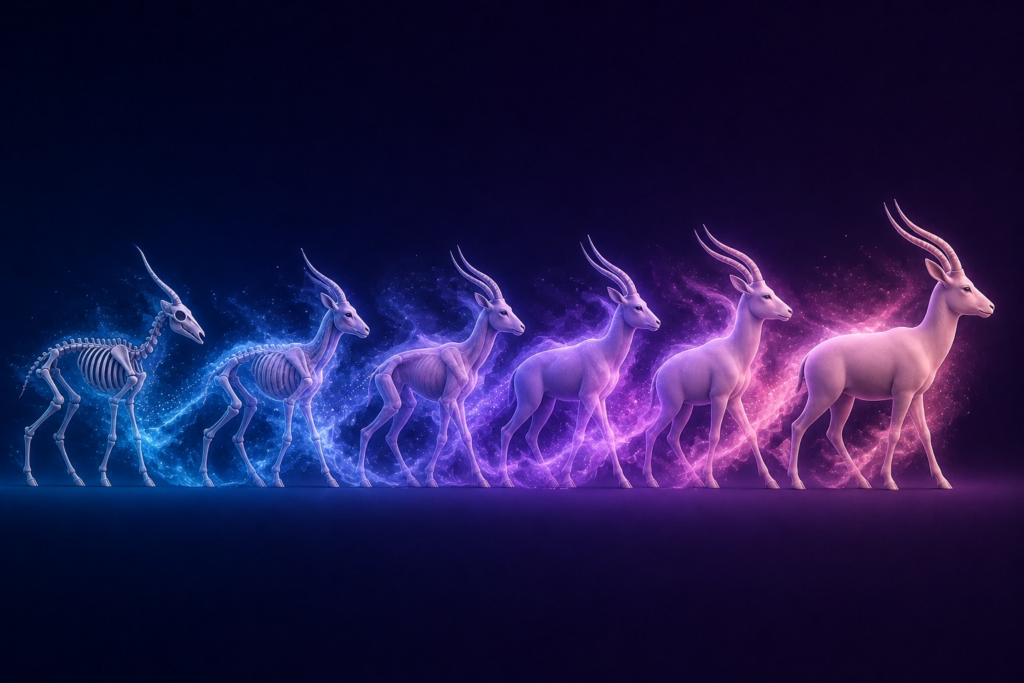
For a long time, extinction occupied a moral category more than a technical one. A species disappeared, conservationists documented the loss, museums held the remains, and the event settled into history as an irreversible fact.
That assumption is starting to weaken.
Colossal Biosciences’ newly revealed effort to revive the bluebuck, alongside its mammoth, dodo, and Tasmanian tiger programs, matters for more than headline shock. The deeper signal is that a growing slice of biotechnology no longer treats extinction as a boundary condition. It treats it as a reconstruction challenge.
That is a profound change in posture.
Once a company can talk seriously about resurrecting a species lost for roughly two centuries, the conversation is no longer just about conservation in its traditional form. It becomes a question of engineering stacks: ancient DNA recovery, comparative genomics, trait inference, gene editing, reproductive biology, surrogate gestation, habitat strategy, and long-term population management. The species is still biological, but the project starts to look more like systems design than like preservation alone.
This is why de-extinction deserves to be read as infrastructure, not spectacle.
The popular version of the story is easy to caricature. Wealthy backers, Jurassic Park headlines, charismatic lost animals, and a company that knows exactly how cinematic its mission sounds. Some skepticism is healthy. These efforts are technically difficult, ecologically fraught, and vulnerable to overselling. A reconstructed animal is not the same thing as rewinding an ecosystem. A viable birth is not the same thing as a self-sustaining species. And a company built around heroic biological feats can still run ahead of the evidence.
Even with those caveats, the category is changing something important.
It is forcing biology into a new frame in which vanished systems are approached as partially recoverable if the information layer is rich enough. That does not mean every extinct species is coming back, or should come back. It means the operating assumption has shifted from “gone means gone” to “gone means technically difficult.” That is a different world.
You can already see the industrial logic beneath the wonder. A serious de-extinction program requires capabilities that spill far beyond one animal. Better genome assembly. Better cellular engineering. Better reproductive interventions. Better models for trait selection. Better ways to manage small founder populations. Those tools can feed conservation, livestock resilience, fertility work, and broader synthetic-biology programs even if the highest-profile species projects move slowly. In that sense, the extinct animal is both the product and the forcing function.
That is where the business case gets stronger than the headline suggests. The immediate commercial value may not come from ticket sales for a revived icon. It may come from the platform built while trying.
There is also a conceptual shift here for conservation. Traditional conservation has often been organized around scarcity, protection, and triage: save what remains before it disappears. That logic does not go away. In fact, it becomes more urgent as ecosystems keep degrading. But de-extinction introduces a parallel logic centered on reconstruction. If species traits, genomes, and reproductive pathways can be modeled and manipulated with enough precision, conservation starts to include design choices that would once have looked implausibly interventionist.
That creates genuine tension. Some ecologists worry that de-extinction will drain attention and capital from protecting living species. Others question whether reconstructed animals belong in modern ecosystems that no longer resemble the ones they left. Those are not minor objections. They go to the heart of whether this field is restoring nature, redesigning it, or doing some unstable combination of both.
Still, it is hard to ignore what the shift implies. Biology is moving into an era where irreversibility itself is under pressure. The point is not that extinction has stopped mattering. It is that extinction is beginning to lose its old status as a purely historical verdict.
When a species becomes something teams can roadmap, fund, prototype, and iterate toward, the category has already changed. The lost world is no longer only a record of absence. It is starting to look, uneasily and fascinatingly, like a backlog.
Join the conversation