The AI Buildout Has Outgrown the Data Center
Overview: Frontier AI infrastructure is expanding beyond traditional data centers into a physical contest over power, cooling, land, grid access, and industrial partners capable of placing compute wherever it can realistically run.
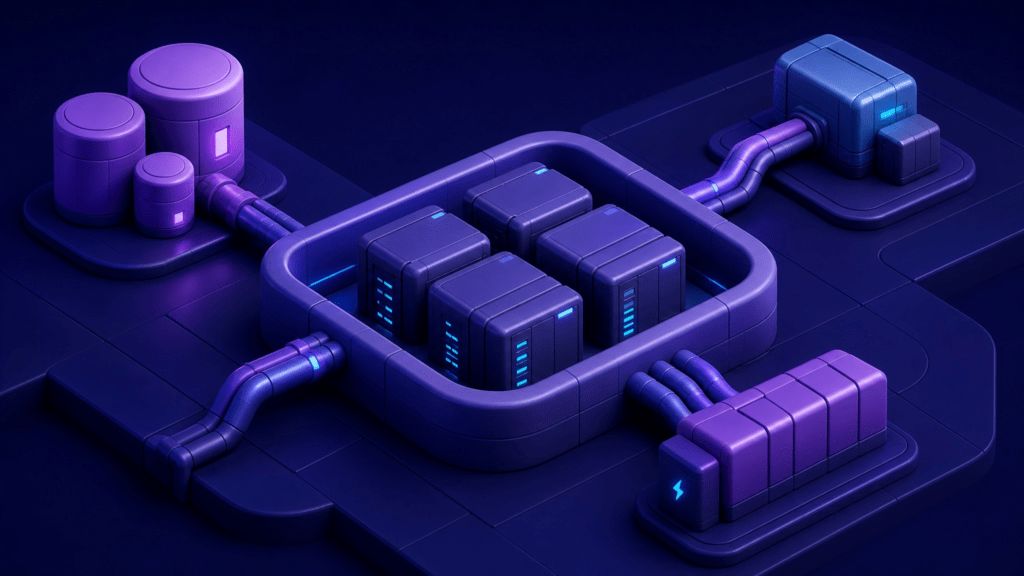
AI infrastructure is no longer contained by the data center. The next contest is over where compute can physically live, how quickly it can be brought online, and which companies can command the industrial machinery required to make that happen.
That is the real signal in Anthropic’s new compute partnership with SpaceX. The headline details are already large enough to sound unreal: access to Colossus 1, more than 300 megawatts of power, over 220,000 NVIDIA GPUs, doubled Claude Code rate limits, and the removal of peak-hour throttling for Pro and Max users. But the numbers matter less as spectacle than as a map of dependence. A smoother coding product is now visibly downstream of power procurement, cooling systems, real estate, grid access, and an infrastructure partner with unusual tolerance for hard physical problems.
The more revealing phrase came from the SpaceXAI side of the announcement, which described the partnership as extending into “multiple gigawatts of orbital AI compute.” That language still has the shimmer of science fiction. It also fits the logic of the ground-level bottlenecks already constraining frontier AI: permitting delays, grid interconnection queues, cooling-water access, transmission capacity, land availability, and the coordination required to bring hundreds of megawatts online on aggressive timelines. When demand rises faster than ordinary infrastructure can be approved, financed, built, and energized, the platform frontier stops looking like a cloud dashboard. It starts looking like a search for new operating environments.
This is a different phase of the AI buildout from the one the market first learned to track. The opening phase was about chips: who could secure accelerators, who could get allocation, who could convert supply into training runs. The next phase made the capital stack impossible to ignore: hyperscaler commitments, sovereign financing, debt markets, energy contracts, and balance sheets large enough to absorb the cost. The phase now taking shape is more literal. Advantage accrues to whoever can move atoms at the pace software demand expects.
That makes SpaceX a strange partner only if AI is still imagined as a conventional software business. SpaceX’s core competencies are not SaaS distribution or enterprise workflow design. They are launch economics, high-throughput manufacturing, large-scale engineering logistics, power systems, thermal management, and the operation of hard infrastructure under hostile constraints. Those capabilities sit outside the old cloud-computing playbook. They become much less peripheral once frontier compute starts pressing against the limits of terrestrial siting.
The platform stack is therefore getting taller, heavier, and less purely digital. A frontier model company now competes through research talent, inference efficiency, product distribution, and enterprise trust, but also through access to electricity and construction capacity. It competes through cooling rights, land deals, and transmission proximity. If orbital compute becomes operationally meaningful rather than merely aspirational, the stack also reaches into launch cadence, satellite architecture, radiation hardening, heat rejection, and space-to-ground networking.
For users, all of this may surface as something deliberately mundane: higher rate limits. A developer using Claude Code does not need to know whether extra capacity came from a conventional data center, an exascale campus, or a more exotic SpaceX arrangement. They care that the tool is available under load, that long-running agentic work does not stall, and that peak-hour throttling disappears. The product improvement is simple. The machinery behind it is not.
That gap between user simplicity and industrial complexity is where platform risk is moving. In the earlier software era, scale meant servers, regions, uptime engineering, and better utilization. In the AI era, scale increasingly means civilization-facing inputs. Electricity is not a cloud SKU. Cooling water is not a feature flag. Land near transmission is not an API. Launch capacity, if it becomes part of the system, is even further from ordinary software procurement. Once those inputs shape product availability, the competitive map starts to include companies that would once have seemed far outside the software category.
There is an important limit to keep in view. Moving compute into more extreme environments does not abolish scarcity. It relocates it. Orbital compute would bring its own constraints: maintenance, radiation exposure, launch cost, debris risk, latency, heat rejection, orbital governance, and geopolitical sensitivity. A space-based cluster is not automatically cleaner, cheaper, or easier than a terrestrial one. It is a wager that some constraints above Earth may prove more tractable, for certain workloads and timelines, than the constraints accumulating on Earth.
The existence of that wager is the point. Companies do not talk seriously about gigawatts of off-planet compute because they have a mild capacity-planning inconvenience. They do it because useful AI consumption is pressing against the normal machinery of infrastructure growth.
For businesses building on frontier models, this changes the vendor question. Model quality still matters, but so do rate-limit policy, capacity guarantees, latency profiles, pricing stability, and the durability of infrastructure partnerships. The stronger platform may not simply be the one with the most elegant model card. It may be the one with the strangest and most defensible logistics advantage.
AI began as a software race, became a chip race, and is now turning into a siting race. The data center is not disappearing. It is losing its status as the final form of compute infrastructure. Frontier AI is becoming a deployment problem measured in power, land, cooling, launch capacity, and the ability to place intelligence wherever it can actually run.
Join the conversation