Biology Is Starting to Look Programmable
𝗢𝘃𝗲𝗿𝘃𝗶𝗲𝘄: Biology is beginning to behave less like a fixed natural substrate and more like an engineering stack that can be observed, edited, and designed with increasing precision.
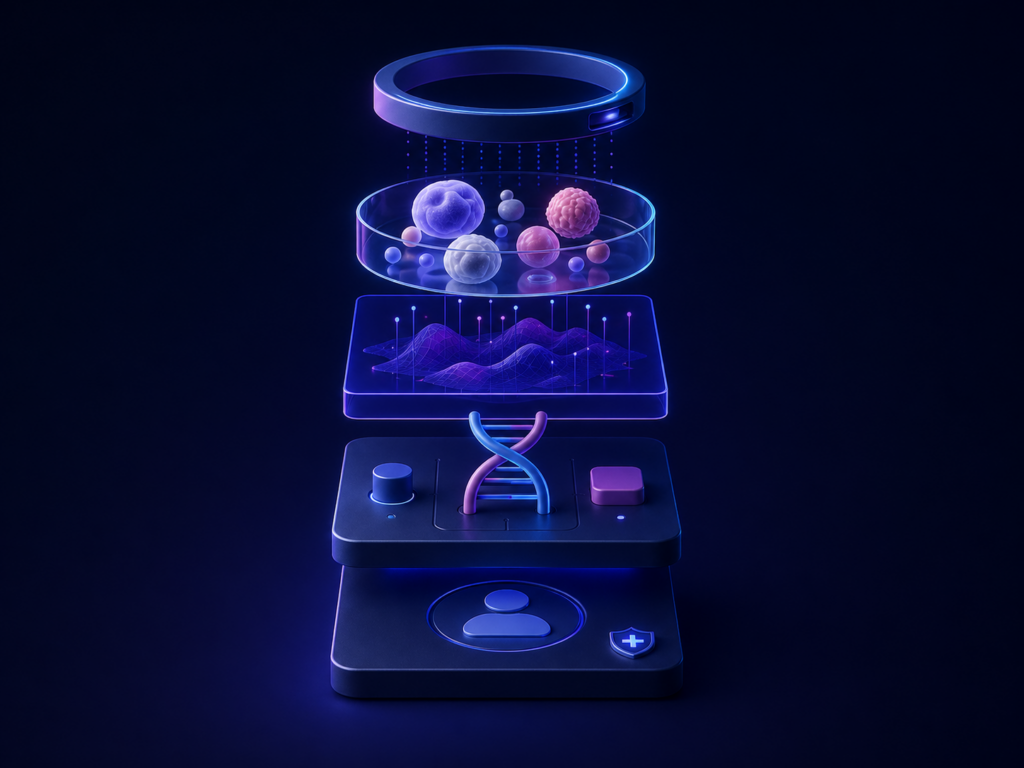
The most important change in biology right now is not a single breakthrough. It is the fact that multiple layers of the field are becoming more engineerable at the same time.
For most of modern biotech history, progress arrived as isolated technical victories: a better sequencing method, a novel therapeutic mechanism, a sharper diagnostic, a more efficient lab technique. Those advances mattered, but they often remained trapped inside narrow categories. The larger system stayed stubbornly fragmented. Biology was rich in discovery and poor in integration.
That is starting to change.
Taken individually, the recent signals already look significant. Kind Biotechnology is reportedly developing integrated organ networks for transplantation. Researchers described in Science a bacterial enzyme capable of synthesizing long DNA without a template, a finding that appears to challenge a basic assumption about how one part of life operates. Work on airborne environmental DNA suggests that biological sensing is becoming less intrusive and more ambient, effectively turning the surrounding environment into a sampling surface. At the clinical layer, tools such as ChatGPT for Clinicians and HealthBench Professional point toward software taking a more serious role in interpretation, review, and medical decision support.
The interesting point is not that these developments belong to the same subfield. They do not. The interesting point is that they increasingly belong to the same stack.
Biology is beginning to look less like a loose federation of scientific specialties and more like an integrated technical system with distinct but increasingly connected layers: sensing, interpretation, synthesis, control, and deployment. Once those layers begin improving together, the field stops behaving like a sequence of disconnected discoveries and starts behaving like an engineering domain.
That shift has strategic consequences.
In an engineering stack, value rarely accrues only to the cleverest isolated capability. It tends to accrue to the systems that connect capabilities into repeatable workflows. Software went through this transition long ago. The durable winners were often not the companies with the single most impressive feature. They were the ones that owned the workflow layer, the integration layer, or the operational surface where many smaller capabilities compounded into something defensible.
Biology now appears to be moving in a similar direction.
That is where AI becomes important, not as a magical substitute for science, but as part of the interpretive and operational layer that makes complex biology more legible and more usable. In clinical settings, that can mean better evidence synthesis, better case summarization, and better decision support. In research, it can mean faster iteration on top of increasingly dense biological data. In industrial settings, it can mean translating biological complexity into systems that are easier to monitor, compare, route, and improve.
In other words, AI matters here because it helps convert biological activity into something closer to an engineering workflow.
That does not make biology easy. If anything, it makes the stakes more obvious. Biology is more variable than software, less forgiving than software, and much harder to standardize. Failure modes are more consequential. Regulatory constraints are real. Many results that sound extraordinary at the headline level will take years to become robust products, and some never will.
But those caveats do not weaken the underlying thesis. They sharpen it.
Once biology starts to become programmable in any meaningful sense, the central competitive question shifts. It is no longer only about who discovered a striking mechanism or published the most surprising result. It becomes about who can assemble sensing, synthesis, interpretation, manufacturing, and deployment into a reliable operating system for biological work.
That is why these current signals matter more in combination than in isolation. Environmental DNA is not just a clever monitoring technique; it hints at a future in which ecology, agriculture, biosecurity, and public health gain a new low-friction sensing layer. Template-free DNA synthesis is not just a biochemical curiosity; it expands the design space for what future biological construction might look like. Organ-growth systems are not only scientific feats; they imply eventual requirements for manufacturing discipline, quality control, logistics, and software coordination. Clinician-facing AI is not merely a productivity tool; it is part of a broader movement in which biological judgment becomes increasingly mediated by computational systems.
Seen together, these are not separate curiosities. They are pieces of an emerging control surface.
That is also why the phrase “biotech breakthrough” is beginning to feel slightly inadequate. It still describes the science, but it misses the systems dimension. The larger story is that biology is becoming more observable, more designable, more operational, and more governable through software-mediated layers.
For builders and investors, that suggests a different lens. The most interesting opportunities may not be confined to the next miracle therapy or the flashiest lab result. They may sit in the connective tissue: the products and platforms that make biological data easier to capture, biological behavior easier to interpret, biological production easier to manage, and biological decisions easier to operationalize responsibly.
That is not a smaller opportunity than classic biotech. It may be a much larger one.
What matters now is not simply whether biology produces another extraordinary result. It is whether the field continues to acquire the properties of a programmable system. If it does, then the center of gravity will move toward the organizations that know how to design, coordinate, and govern that system at scale.
At that point, biology will no longer look like a collection of remarkable exceptions. It will start to look like one of the most consequential engineering platforms of the coming decade.
Join the conversation