Compute Is Rewriting the Economy
Overview: AI infrastructure spending has become large enough to reshape capital markets, turning compute from a tech-sector cost center into a macroeconomic force that influences power, chips, real estate, and national capacity.
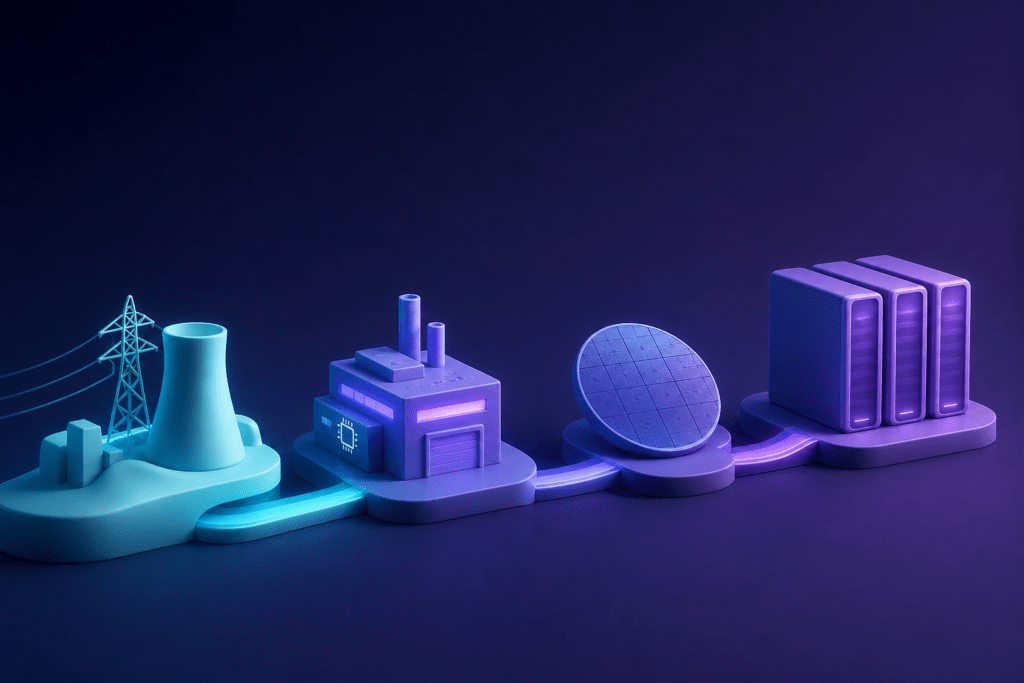
The AI race is getting large enough to stop looking like a normal technology cycle. It is starting to look like a reorganization of the economy around compute.
That is the real signal inside the latest capex numbers. Morgan Stanley now expects the five hyperscalers to spend about $805 billion in 2026 and $1.1 trillion in 2027, roughly matching all non-tech S&P 500 capital expenditure combined. Those figures are large enough that it becomes misleading to describe AI infrastructure as just one more growth category inside tech. The infrastructure race is becoming its own macroeconomic force.
That shift changes the meaning of AI investment. For the past two years, it was easy to narrate the boom mainly through models, products, and consumer adoption. Those things still matter, but the more consequential story now sits underneath them. Data centers, power systems, GPU fleets, semiconductor-adjacent manufacturing, and financing structures are starting to determine which companies and countries can stay in the race.
You can see the scale of the shift in how people are beginning to justify it. David Sacks argued that AI accounted for 75% of first-quarter GDP growth, with a capex tailwind of roughly 2.5% to 3%. Whether or not one accepts that framing in full, it captures something important: AI spending is no longer being defended merely as a venture-style bet on future upside. It is being framed as a current engine of national growth.
That is a meaningful political transition. Once a sector becomes legible as GDP support, it stops being discussed like a niche innovation wave and starts being treated more like infrastructure, industry, and strategic necessity. At that point the questions change. The issue is no longer only who has the smartest model. It becomes who can finance the buildout, secure the energy, raise utilization, absorb the inefficiency, and keep the industrial system fed.
Utilization is an underappreciated part of this. xAI is reportedly using only 11% of its 550,000 Nvidia GPUs, while Meta and Google are said to be operating in the mid-40% range. That suggests a strange reality in the current boom: the constraint is not simply buying more compute. It is learning how to turn vast purchased capacity into productive, orchestrated capacity. The companies that master scheduling, workload design, energy use, and deployment throughput may end up with a quieter but more durable edge than the ones that merely announce the biggest clusters.
The physical form of the buildout is getting stranger too. The Financial Times reports that Japan’s data-center market could grow by roughly 50% by 2030, with 52-meter vertical facilities rising in urban Tokyo parking lots because land is too scarce for the usual sprawl. At the same time, Starcloud is reportedly in talks for a $2.2 billion valuation to build solar-powered data centers in low Earth orbit. One response goes upward because cities are dense. Another goes all the way off-planet because terrestrial energy and cooling look increasingly constrained. Those are not normal extensions of software demand. They are signs of a civilization trying to locate enough room for machine intelligence.
Even the secondary beneficiaries tell the story. Toto, best known internationally for toilets, saw its shares jump after revealing that it has become the world’s second-largest producer of electrostatic chucks used in NAND chip manufacturing, according to the Financial Times. That kind of detail matters because it shows how AI demand is rewarding companies far from the consumer-facing narrative. The value capture is spreading into obscure industrial niches, not just the obvious model labs and cloud giants.
For builders and investors, this means the stack is widening again. It is still rational to chase applications, copilots, and model improvements. But the next wave of durable value may sit in power management, cooling, orchestration software, utilization optimization, chip-manufacturing dependencies, and the financial plumbing that allows trillion-dollar capex to keep compounding without blowing holes in balance sheets. The glamour remains at the model layer. The leverage is increasingly below it.
There is also a real tension here. Capital intensity of this scale tends to concentrate power. The more expensive AI infrastructure becomes, the harder it is for smaller firms, poorer countries, and independent labs to compete on equal footing. A world organized around compute abundance could also become a world organized around compute feudalism, where a narrow group of firms owns the capacity everyone else must rent.
That is why the capex story matters beyond earnings calls and datacenter gossip. AI is no longer just producing new software. It is reorganizing investment priorities, industrial bottlenecks, and national growth stories around the machinery required to sustain machine intelligence. Once that happens, the technology cycle has already become something larger.
Join the conversation