The Price of a Clean Room
Overview: A robotics startup offering free home cleanings in exchange for camera footage shows the deeper bargain behind domestic automation: home robots will need intimate, consent-heavy data about private spaces before they can become useful, making trust, privacy, and restraint as important as hardware or model capability.
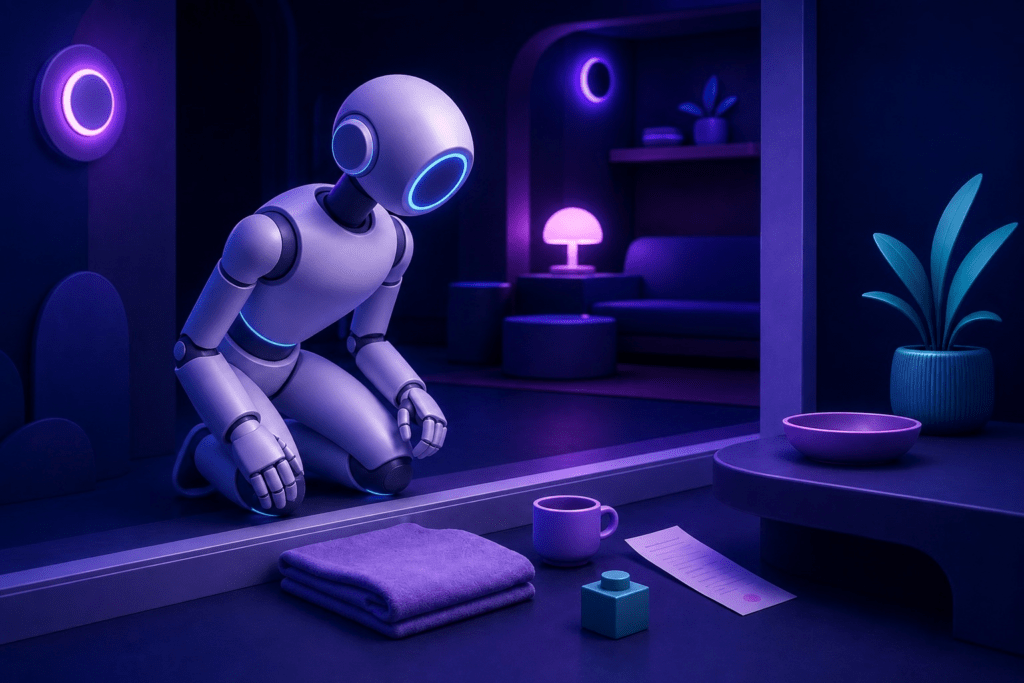
Home robotics is entering its most intimate phase. Before robots can clean, sort, fold, and move through ordinary domestic life, they need to understand the private disorder of human space.
There is a particular kind of intelligence hidden in an ordinary kitchen at the end of a long day.
It is not written down. It is not captured in a benchmark. It lives in the half-folded towel on the chair, the glass that should not go in the dishwasher, the receipt that looks like trash until someone remembers it matters. It lives in the way a person knows which pile is clutter and which pile is a system.
A home is full of invisible rules. Every room is a small civilization with its own laws, habits, shortcuts, and exceptions.
For years, robotics made progress by avoiding that world.
Factories were easier. Warehouses were easier. Roads, for all their danger, could still be mapped, bounded, and negotiated in public. The machine could be given lanes, signs, tolerances, and procedures. The world could be simplified into something repeatable.
Homes are different.
They are not structured for machines. They are structured around memory, fatigue, taste, privacy, and the quiet disorder of being alive. The hard part is not just that homes are messy. It is that the mess often means something.
Now the machine is asking to come inside.
A robotics-training startup called Shift is reportedly offering free home cleanings in New York City if residents agree to let workers wearing cameras record the process. The bargain is simple: humans clean the home, cameras capture the work, and the footage becomes training data for household robots.
It is almost too perfect as a symbol.
The resident gets a cleaner apartment. The company gets the apartment as evidence. The dust becomes data.
The sink, the laundry, the medicine bottle, the unpaid bill, the private archaeology of a week lived indoors, all of it becomes part of the machine’s apprenticeship.
This is the less cinematic frontier of embodied AI. Not the gleaming humanoid stepping through a polished demo. Not the robot hand solving a staged task under perfect lighting. The real frontier is someone with a camera on their head standing in a stranger’s kitchen, documenting how people actually rescue order from chaos.
That image tells us something important about the future of robotics.
The hard problem is not only motion. It is permission.
A robot vacuum was allowed into the home because its world was low to the ground and morally simple. Map the floor. Avoid the stairs. Return to the dock. Its mistakes were annoying, but usually understandable.
A general-purpose home robot inherits a much heavier burden. It has to know what to touch, what to leave alone, what to throw away, what to preserve, what to hide, what to ask about, and when the correct action is no action at all.
A kitchen counter is not just a surface. It is a living index of human priorities.
A child’s drawing under a stack of mail is not clutter in the same way a takeout wrapper is clutter. A wine glass in the sink is not the same object as a cracked mug on the floor. A pile of papers may look like disorder, but to the person who lives there, it may be a working system.
A machine that cannot read that context will not feel helpful. It will feel invasive, careless, or dangerous.
Simulation can only carry the industry so far. A lab can create drawers, dishes, fabrics, and obstacle courses. It can teach a robot to open cabinets, identify objects, and navigate around furniture. But it cannot fully manufacture the private logic of ten thousand homes.
It cannot invent every bad habit, every cramped floor plan, every half-broken appliance, every sentimental object with no visible value.
Domestic robotics needs the world in its unedited form. The problem is that the unedited world belongs to people.
That is where the next phase of robotics becomes less like hardware and more like trust.
The companies that matter will need more than actuators, foundation models, and impressive demos. They will need consent systems, privacy guarantees, data deletion rights, worker protections, bystander rules, and a credible way to explain what is being collected, why it matters, and when it disappears.
They will need to prove that the home can teach the machine without becoming a surveillance annex.
That is what makes the Shift example feel so charged. It collapses the future into a simple question: what is a clean apartment worth if the price is letting the machine study your life?
Some people will say yes. Many already trade privacy for convenience in smaller ways every day. Cameras guard doors. Phones listen for wake words. Apps know where we sleep, eat, shop, and hesitate. The bargain is not new.
The difference is proximity.
A device on the counter observes the room. A cleaner moves through it. A future robot will touch it.
Touch changes the moral weight of automation. A chatbot can misunderstand your preferences. A machine in the home can physically rearrange the evidence of your life. It can move the thing you needed, discard the thing you meant to keep, expose the thing you meant to hide.
That makes trust less abstract. It becomes physical.
The real moat in domestic robotics may not be a single model or a single robot body. It may be the right to learn from ordinary life at scale. The company that can gather that data ethically, protect it credibly, and turn it into reliable behavior will own something far more valuable than footage.
It will own a path into the most protected space people have.
That should make us pause.
The home has always been where the world is allowed to be incomplete. Dishes undone. Laundry unfolded. Habits unpolished. Identity scattered in objects no outsider can fully interpret.
To automate that space, machines have to learn more than tasks. They have to learn restraint.
Before the robot can clean the room, it has to learn what the room means. Before it can learn what the room means, someone has to let it look.
And once we teach machines to see inside our homes, the real question may not be what they can do for us.
It may be what they will come to know about us that we never meant to teach.
Join the conversation